

Today I have an in-depth Interview with Allison Symes who has known as The Queen of Flash in Literary Circles. Thank you Allison for joining me her and providing such sound advice for our readers.
Allison Symes interviewed by Wendy H. Jones
The Nuts and Bolts of Flash Fiction
Firstly, congratulations on the publication of your newest flash fiction anthology. Thank you for taking the time to answer my questions as I know you are busy.
1. Let’s start at the beginning and pin our colours to the mast. What exactly is flash fiction?
Flash fiction, Wendy, is any story which is 1000 words or fewer. Flash has been around for centuries. Many of Aesop’s Fables and Jesus’s parables would count as flash fiction due to their word counts. Flash has also been known by other names such as postcard fiction.
2. What draws you to writing this genre?
I love the challenge of it. Each story is its own challenge whether I write to 50 words or the full 1000 allowed. It is also character led. The characters have to “lead” the action because there isn’t the word count room for lots of description. I’ve always loved inventing characters so this is another attraction to the form for me.
3. Flash fiction is currently growing in popularity. Why do you think this is?
It is perfect for people who want to read but don’t have as much time to read as they’d like. People are more used to reading on screens these days and that helps too. Flash works beautifully on phones, tablets etc. Also, schoolchildren in the UK have an annual opportunity to join in with BBC Radio 2’s 500 words competition and that helps get the form better known too (and to their parents as well).
4. For anyone who wants to write it, what is the first step?
I say go for it. Think about what themes interest you, what kinds of characters interest you. The important thing is to get your story written, rest it for a while so you come back and look at it with fresh eyes to see what works and what doesn’t.
When you’re happy with the story, then worry about the word count, though I should add sometimes I’ve written a story for a 100 word competition and it genuinely works better at a longer word count. I leave it alone and write another 100 worder for the competition. The story has to be “right” for the character.
But you can do a lot of good work in getting rid of wasted words such as that, actually, very, pretty much all of the adverbs (go for a strong verb instead), repetitions (unless deliberately done for effect). Doing all of that tightens up your story and reduces your word count a lot.
5. What would you say is the most important fact to remember when writing flash fiction, and why?
It’s all about the character. Your characters have to show the reader what is going on. We need to be able to follow what they are up to and why and understand where they’re coming from, even though we may not agree with what they’re doing. Your character needs to grip us so we want to find out what happens to them. Mind you, that is true for longer fiction too. One of the benefits of flash fiction is it does tighten up your writing as you learn to get rid of parts of the story which aren’t moving it on and that is a transferable skill. I’ve found it has helped with my blogging and article work, for example.
6. With flash fiction what you leave out is as important as what you put in? How do you decide what stays and what goes?
This is a great question. The way I deal with this is to focus on what the reader must know. For example, in a piece of crime flash fiction, I might need the reader to know the character comes from a rich background so doesn’t need the money they’re hoping to get from their crime. So that will intrigue a reader. They will want to find out why the character is doing this at all then. Everything has to move the story on in some way and that is also a great way to work out what should stay and what should come out of my drafts.
7. We all know the importance of openings in short stories and novels. How important is the opening of a flash fiction story and how does one go about crafting one?
Opening lines of any story have to hook the reader in because it is these which will make the reader continue with your story. For a flash fiction story, it is even more important. It has to set either the scene or the character (and it can do both). You have to “hit the ground running”.
As for crafting one, you need to decide whether the story is going to start with dialogue or internal thoughts by the character or not. Both dialogue and thoughts show something of the character’s attitude (and likely educational status/class depending on which words you give your character to say) to your reader. I love writing dialogue. It is like eavesdropping on a conversation which probably says something about me! Having said that, your readers will feel the same and should want to find out what else your character has to say.
If you decide to start your story by showing something of the scene, focus on what the reader has to know, and the scene has to be intriguing enough to grip them. Just to give you an example from Seeing The Other Side, these opening lines are taken from Smashing Sally.
Smash! Sally stopped cleaning Mr Harry’s table to see Ethel Price look at a broken plate with chocolate cake scattered everywhere.
Without saying so, you should guess from this the story has to be set in a care home and I would hope you would wonder what happens next.
However you start a story, you want a reader to want to find out what happens next.
8. Characterization is the crux of most stories. Please let us know how you can develop memorable characters in such a short word count?
The thing to remember is you can’t put everything into a flash fiction story. (Not a good idea to put everything into longer fiction either). Focus on what a reader needs to know only. I can’t stress that point enough.
In my example above, you know Mr Harry and Ethel Price have to be elderly people as the names and the title of Mr for Harry implies that. You know Sally is a cleaner because you “see” her at work. What mattered there was you needed to know she is a cleaner. The whole story hinges around that fact.
Also you can show characterisation via dialogue, internal thoughts, and their mood as they do things. It wasn’t apt for Sally above as she’s not the kind of character to do this but I could have shown her throwing her cleaning cloth down and stomping on it because she has yet more mess to clear up. If I had done this, you would have known her mood immediately.
Characters do have to lead flash fiction. You see their world through their eyes so they show you what you need to know. You can infer the rest.
The best description of flash I’ve come across is from The Bridport Prize which refers to it as “the art of just enough”.
9. Is there anything else you feel my readers should know about writing flash fiction?
If readers have had a go at any kind of writing exercise, they will have been writing some flash fiction. You’re usually given a few minutes to have a go at the writing exercise the tutor has set you. You’re not going to write more than a couple of hundred words at most in that time. Perfect flash territory.
It is also useful as a warm up writing exercise for those who would usually write longer works.
There are many competitions for flash and it is possible to have published collections of flash as Seeing The Other Side proves.
Flash is also so useful in helping writers develop editing skills on their own work.
And for readers?
Flash is the perfect read when you’d like to read but don’t have much time.
Nothing to dislike about that!
Review of Seeing the Other Side -Wendy H. Jones
I know when I settle down with an anthology by Allison Symes it is going to be a cracking read. Not only are the stories in her books enthralling, they are also thought provoking. This latest volume does not disappoint. Several times whilst I was reading it I had to put the book down and think about what I had just read. The stories are multifaceted and made me think on several levels. I also liked the way in which they were intertwined in many ways. This is a cracking flash fiction collection which I would highly recommend to both readers and those studying the genre.
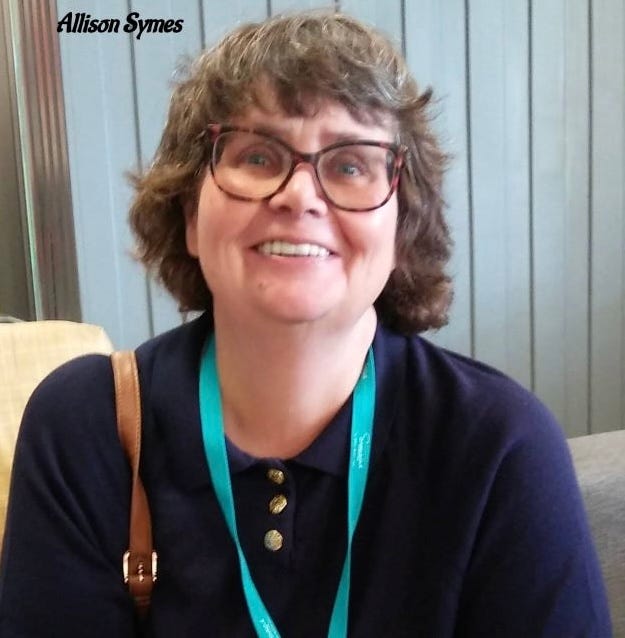
Allison Symes - Author Bio, Social Media and Buy Link
Allison Symes, who loves reading and writing quirky fiction, is published by Chapeltown Books, CafeLit, and Bridge House Publishing.
Her flash fiction collections, Seeing The Other Side, Tripping The Flash Fantastic and From Light to Dark and Back Again are available in Kindle and paperback. She has been a winner of the Waterloo Arts Festival writing competition three years in a row where the brief was to write to a set theme to 1000 words maximum.
She also writes short stories and has contributed to many CafeLit anthologies over the years, her first printed story appearing in 2009. She was a regular writer for the now defunct Friday Flash Fiction and some of her stories were chosen as the Editor’s Choice for the week.
She has had flash fiction stories broadcast on Hannah Kate’s show on North Manchester FM, most recently in March 2026, and has also been interviewed by Hannah.
She has run workshops at The Writers’ Summer School, Swanwick, the London Jesuit Centre, and others. She has also spoken at groups in person and online. She was also a speaker at the Scottish Association of Writers conference where she ran a workshop and judged a competition for them. Allison has judged flash fiction competitions for writing groups.
Website:
https://allisonsymescollectedworks.com/
Books: http://author.to/AllisonSymesAuthorCent
Substack: https://substack.com/@allisonsymeswriter1
YouTube: https://www.youtube.com/channel/UCPCiePD4p_vWp4bz2d80SJA/
With her non-fiction hat on, Allison blogs for online magazine, Chandler’s Ford Today, often on topics of interest to writers. Her weekly column can be found at http://chandlersfordtoday.co.uk/author/allison-symes/
Allison blogs for Authors Electric and More Than Writers, the blog spot for the Association of Christian Writers (ACW). She runs monthly flash fiction workshops for ACW too.
She also writes monthly for Writers’ Narrative e-magazine on a variety of topics and judges flash fiction competitions.
She is also a freelance editor who also carries out work for a small independent press.
She is a long term member of the Society of Authors, Chartered Institute of Editing and Proofreading, and Association of Christian Writers.
Blurb – Seeing The Other Side by Allison Symes
Perspective can be wonderful but will you still feel the same if your view from the fence changes?
Allison Symes has long loved what can be done with flash fiction in terms of genre and even how it is presented. Here, you will find flash tales covering a wide range of genres. Some are written in acrostic format, some are linked flashes where a character will turn up in two or more tales revealing more about themselves as the stories go on, and many will make you laugh. Others will make you shudder. Justice is served in some of the tales too, though whether it is to the characters’ liking is another matter. Flash fiction is perfect for any mood or genre. Oh and a Canada Goose comes into the book too.
Allison Symes, author of Seeing The Other Side, Tripping The Flash Fantastic and From Light to Dark and Back Again is passionate about flash fiction and hopes her latest collection introduces more to the joy and fun of the form.
While my novels are quick reads, I haven't as yet tried Flash Fiction. It may be a good way to attract an interview.